I’ll admit it—I almost bought a fake opal the first time I shopped online.
The photos looked gorgeous. Bright rainbow flashes, super affordable, and the reviews were full of “so pretty!” comments. But something felt…off.
After owning a few real opal rings (and accidentally buying a fake one 😅), I’ve learned a few simple tricks that make spotting the difference much easier.
If you’re wondering whether an opal is real, here’s what I always look for.
1. Real Opals Never Look Exactly the Same
This is probably the biggest giveaway.
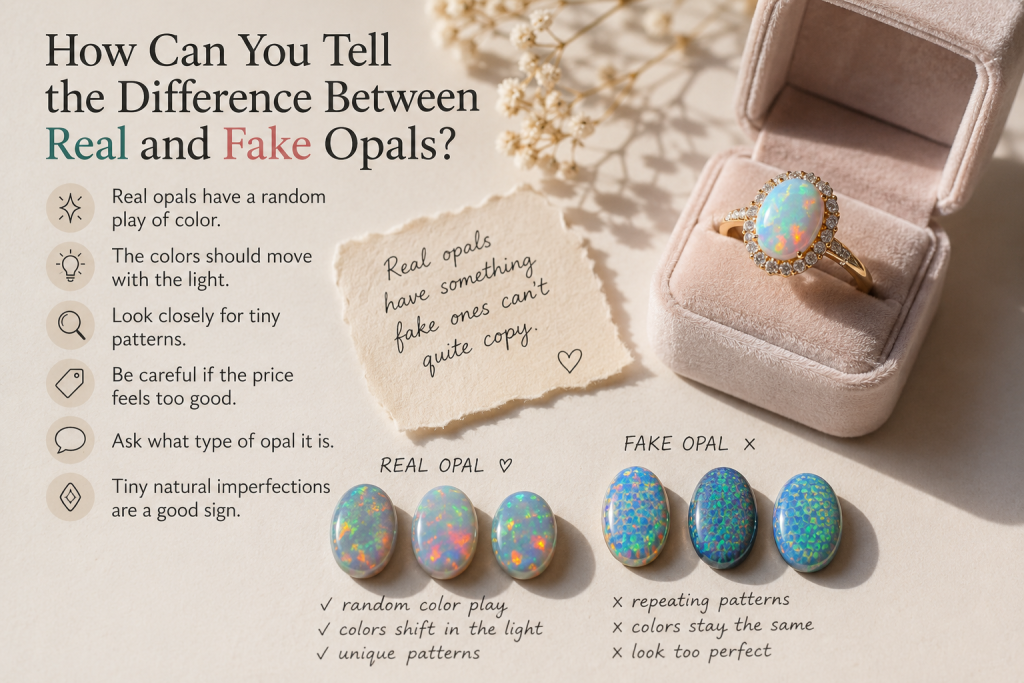
A genuine opal has a really natural, random play of color. You’ll notice little flashes of blue, green, orange, pink, or red that seem to move every time you tilt the stone.
No two areas look identical.
Fake opals often have colors that repeat in a pattern, almost like wallpaper. Once you’ve seen it, it’s hard to unsee.
If it looks too perfect, I usually get suspicious.
2. The Colors Should Move With the Light
One of my favorite things about real opals is that they never look the same twice.
I’ll glance at my ring indoors, then step outside, and suddenly completely different colors appear.
That’s what makes them feel almost magical.
Fake stones usually stay pretty much the same no matter how you move them.
3. Look Closely for Tiny Patterns
Whenever I shop in person, I ask if I can look through a jeweler’s loupe.
Real opals have a natural, organic texture.
Many imitation opals have repeating “snake skin,” “lizard skin,” or mosaic-like patterns because they’re made in a lab or printed to imitate natural color play.
It’s one of those details that’s surprisingly easy to notice once you know what you’re looking for.
4. Be Careful If the Price Feels Too Good
I love a bargain as much as anyone.
But if someone is advertising a huge, incredibly colorful “Australian black opal” for $25…
That’s usually a red flag.
Real high-quality opals are rare, especially black opals with bright color flashes.
A low price doesn’t automatically mean fake, but it definitely makes me ask more questions.
5. Ask What Type of Opal It Is
This is something I never knew when I first started shopping.
Not every genuine opal is a solid natural stone.
You might come across:
- Natural solid opals
- Doublets
- Triplets
- Lab-created opals
Some doublets and lab-created opals are perfectly beautiful—they just shouldn’t be sold as rare natural stones.
A trustworthy seller should happily explain exactly what you’re buying.
6. Tiny Natural Imperfections Are Actually a Good Sign
Real gemstones aren’t perfect.
Sometimes you’ll notice tiny inclusions, little uneven color patches, or natural lines inside the stone.
That’s completely normal.
Ironically, the stone that looks absolutely flawless can sometimes be the fake one.
My Biggest Shopping Rule
If a listing only shows one heavily edited photo…
I move on.
I like sellers who show videos, natural daylight photos, different viewing angles, and close-up shots.
Real opals are impossible to capture in just one picture because they change so much with the light.
Final Thoughts
After collecting a few opal pieces, I’ve realized that real opals have something fake ones can’t quite copy.
They feel alive.
Every time I wear mine, the colors surprise me a little differently depending on the sunlight, my outfit, or even the weather.
So if you’re shopping for an opal, don’t stress about becoming a gem expert overnight.
Just remember these simple checks:
- Random, unique color patterns
- Colors that shift as you move the stone
- No obvious repeating designs
- A realistic price
- Honest information from the seller
A little extra attention before you buy can save you from disappointment—and when you finally find a genuine opal, you’ll understand why so many people fall in love with them. 💙