The first time I held a natural opal, I honestly couldn’t stop turning it under the light. Every tiny movement revealed different flashes of blue, green, orange, and sometimes even pink. It almost looked alive.
That made me curious.
How is opal formed? Is it volcanic? Does it grow like crystals? Why does every stone look completely different?
I ended up reading way more about opals than I expected, and now it’s one of my favorite gemstones simply because its story is unlike almost anything else in nature.
So if you’ve ever wondered how opal actually forms, here’s the version I wish someone had explained to me.
Surprisingly… Opal Isn’t a Crystal
This was the biggest surprise for me.
Most gemstones—like sapphires, rubies, or diamonds—form as crystals under intense heat and pressure.
Opal doesn’t.
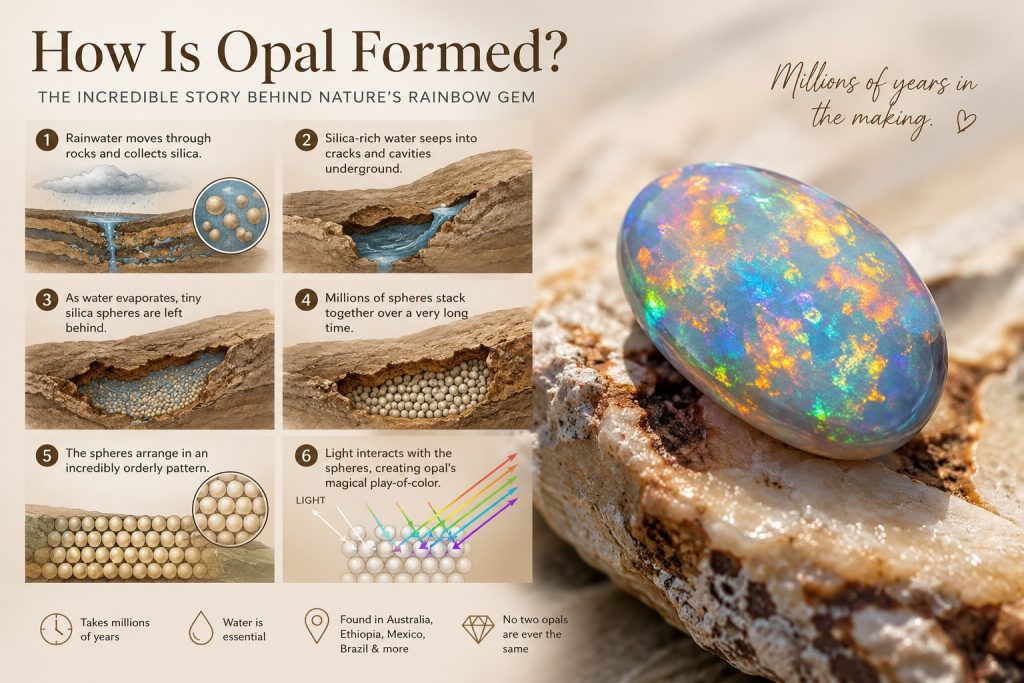
Instead, opal is made from tiny silica particles mixed with water.
Millions of years ago, water slowly traveled through rocks, picking up dissolved silica along the way. As that water seeped into cracks, cavities, or spaces underground, it eventually began to evaporate.
Little by little, it left behind microscopic silica spheres.
Those tiny spheres slowly stacked together over an incredibly long time, eventually becoming what we know as opal.
It’s basically nature working at an unbelievably patient pace.
Water Is the Real Hero
One thing I never realized is how important water is.
Without water, there wouldn’t be opal.
Rainwater moves through sandstone and volcanic rocks, dissolving silica from surrounding minerals. Then gravity carries that silica-rich water deeper underground.
As the environment changes and the water slowly disappears, the silica remains behind.
Imagine making layers of sugar syrup that slowly harden after the liquid evaporates—that’s obviously an oversimplified comparison, but it helped me picture the process.
Nature just does it over millions of years instead of overnight.
Why Does Opal Have So Many Colors?
This was my favorite part to learn.
People often think the colors come from minerals mixed inside the stone.
Actually… not really.
The famous rainbow effect—called play-of-color—happens because those tiny silica spheres are arranged in an extremely orderly pattern.
When light enters the stone, it bends and scatters between the perfectly sized spheres.
Different sphere sizes reflect different wavelengths of light.
That’s why one opal might flash electric blue while another glows with fiery reds and oranges.
It’s almost like nature built millions of microscopic prisms inside the gem.
Honestly, once I learned that, I appreciated natural opals even more.
Why Some Opals Don’t Show Rainbow Colors
Not every opal displays that magical rainbow.
Some are known as common opal, which usually appears milky, white, pink, blue, or green without flashes of color.
The reason is simple.
Inside common opal, the silica particles aren’t arranged in neat, uniform rows.
Without that organized structure, light can’t create the dramatic color play.
They’re still beautiful—just in a quieter way.
How Long Does It Take an Opal to Form?
This is probably the question I get asked most after people hear I collect gemstone jewelry.
The short answer?
A very, very long time.
Scientists believe natural opals generally take millions of years to develop.
The exact timing depends on things like:
- How much silica is available
- Underground water movement
- Temperature
- Geological stability
- Space for the silica to collect
There’s no exact countdown, but it’s definitely not something that happens quickly.
That’s one reason natural opals feel so special to me.
You’re wearing something that nature spent ages creating.
Where Are Most Natural Opals Formed?
When people think of opals, Australia usually comes to mind first—and for good reason.
Australia produces the majority of the world’s precious opals, including the famous black opals.
But beautiful natural opals also come from:
- Australia (especially black, white, and boulder opals)
- Ethiopia (known for bright crystal opals)
- Mexico (famous for vibrant fire opals)
- Brazil
- Honduras
Each location has different geological conditions, which is why opals from different regions often have their own personality.
I actually love comparing them because no two seem exactly alike.
Why Every Opal Looks Different
This is probably my favorite thing about opals.
Two diamonds can look incredibly similar.
Two sapphires might be nearly identical.
But natural opals?
I’ve honestly never seen two that were exactly the same.
Every stone formed in a different crack, under different conditions, with different water movement and different silica arrangements.
That’s why each one has its own unique pattern.
Some look like tiny galaxies.
Others remind me of ocean waves.
Some flash bold neon colors, while others have soft pastel glows.
It’s one of the few gemstones where imperfections often make the stone even more interesting.
Are Lab-Created Opals Formed the Same Way?
Sort of—but much faster.
Scientists can recreate the same silica sphere structure inside a laboratory.
The result is a lab-created opal that often displays beautiful rainbow colors.
The difference is mostly the timeline.
Nature takes millions of years.
A laboratory can produce a similar structure in months.
Both can be beautiful, but if you’re someone who loves the story behind a gemstone, there’s something incredibly meaningful about wearing a stone that formed naturally over such an enormous span of time.
Why Learning This Made Me Appreciate Opals More
Before I learned how opals formed, I mostly liked them because they were colorful.
Now I see them differently.
Every flash of color represents tiny silica spheres lining up with almost impossible precision.
Every pattern is the result of water slowly moving through the earth over millions of years.
Every natural opal carries a geological story that’s impossible to duplicate exactly.
Whenever I catch my opal ring sparkling in the sunlight now, I don’t just see a pretty gemstone.
I see millions of years of patience from nature—and somehow that makes it feel even more magical.
People also ask
- Can Aries Wear Opal? Here’s What Happened When I Finally Tried It
- Do Opal Rings Have Any Value? Here’s What I Learned After Falling in Love With Opals
- What Month Is the Birthstone Opal? Here’s Why October Girls Are So Lucky
- What Is the Spiritual Meaning of Black Opal? My Honest Experience With This Mysterious Stone