While most gemstone enthusiasts are familiar with the white and black opals of Australia, Idaho produces some of the most geologically unique opals on Earth. Born from intense Cenozoic volcanic activity, Idaho opals are characterized by their high water content, incredible transparency, and fascinating layered formations.
Understanding the scientific differences between these varieties is essential for rockhounds, gemologists, and jewelry collectors alike. Here is a deep dive into the distinct varieties, colors, and traits of Idaho opals.
🌋 The Volcanic Genesis of Idaho Opals
Unlike Australian opals, which formed in ancient sedimentary basins over tens of millions of years, Idaho opals are purely volcanic. Approximately 4 to 15 million years ago, massive rhyolite eruptions tore through what is now the Pacific Northwest.
As the molten lava cooled, trapped volcanic gases formed millions of tiny pockets (called vugs) and fractures in the host rock. Over millennia, superheated, silica-rich groundwater flooded these cavities. As the water slowly evaporated, it left behind orderly spheres of amorphous silica—creating the dazzling gemstones we find today.
🌈 4 Unique Varieties of Idaho Opals
The specific mineral trace elements present during deposition dictated the wildly diverse colors and patterns found across the state.
       [ Idaho Opal Variety Matrix ]
┌─────────────────┬──────────────────────┬───────────────────────┐
│ Variety Name    │ Primary Colors       │ Optical Phenomenon    │
├─────────────────┼──────────────────────┼───────────────────────┤
│ Spencer Layered │ Multi-color neon     │ Ultra-thin fire bands │
│ Star Opal       │ Gold / Bronze / Pink │ Asterism (4-to-6 ray) │
│ Idaho Blue      │ Pastel blue / Teal   │ Opalescent haze       │
│ Fire & Jelly    │ Cherry-red / Amber   │ High-clarity glow     │
└─────────────────┴──────────────────────┴───────────────────────┘
1. Spencer Layered & “Geyser” Opals
The signature gemstone of the Spencer region is uniquely layered. Rather than forming a massive solid chunk, the silica was deposited in exceptionally thin, ultra-bright layers (often just millimeters thick) inside rhyolite fractures.
-
- The Look: Highly transparent “water” or “jelly” body color illuminated by explosive, neon-like flashes of green, red, and violet.
- Geyser Opals: A rare subset found near ancient hydrothermal vents, showing unique circular or bubbling flow structures trapped within the gem matrix.
2. Idaho Blue Opals & Thundereggs
Found primarily in southern Idaho, these stones owe their soothing, hazy blue and teal hues to micro-inclusions of copper or silicate minerals.
-
- The Look: They range from completely opaque common opal to semi-translucent precious blue opal.
- Blue Thundereggs: Often found acting as the hidden center-filling of volcanic chalcedony nodules. When sliced open, they reveal a stark contrast between a rugged exterior and a glassy, sky-blue interior.
3. Idaho Fire & Jelly Opals
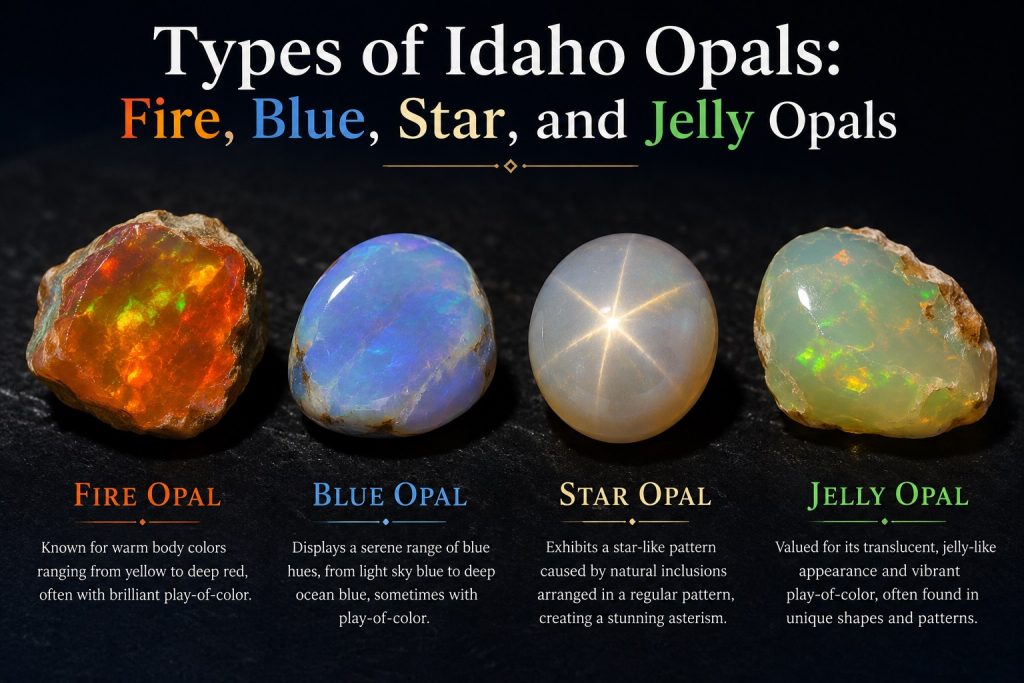
Often drawing comparisons to Mexican fire opal, Idaho’s fire varieties range from warm yellow to deep, moody cherry-red.
-
- The Look: Unlike layered opals, these often form as solid, thicker nodules. “Jelly” opals refer to specimens that are completely translucent, looking exactly like drops of colored gelatin that capture and glow under ambient light, even without a strong play-of-color.
4. The Elusive Idaho Star Opal
Perhaps the rarest variety in the state, the Idaho star opal is a collector’s Holy Grail.
-
- The Look: When cut into a cabochon (a smooth, rounded gem), microscopic, needle-like inclusions of rutile or actinolite align perfectly within the silica structure. When caught under a single light source, they reflect a sharp, moving 4-ray or 6-ray star across the surface of the gem (a phenomenon known as asterism).
🧐 Are Idaho Opals True “Jelly Opals”?
Yes, a vast majority of high-grade precious opal from Idaho naturally falls under the Jelly Opal or Water Opal classification due to its exceptional clarity. If you hold a raw slice of Spencer opal up to a book, you can often read text right through it.
However, this extreme transparency creates a unique challenge: when placed directly against skin or light backings, the vibrant fire can disappear as light passes completely through the stone. To remedy this, master cutters slice the thin, jelly-like precious layers and mount them onto dark backings (making doublets or triplets), which traps the light and forces the fire to explode outward.