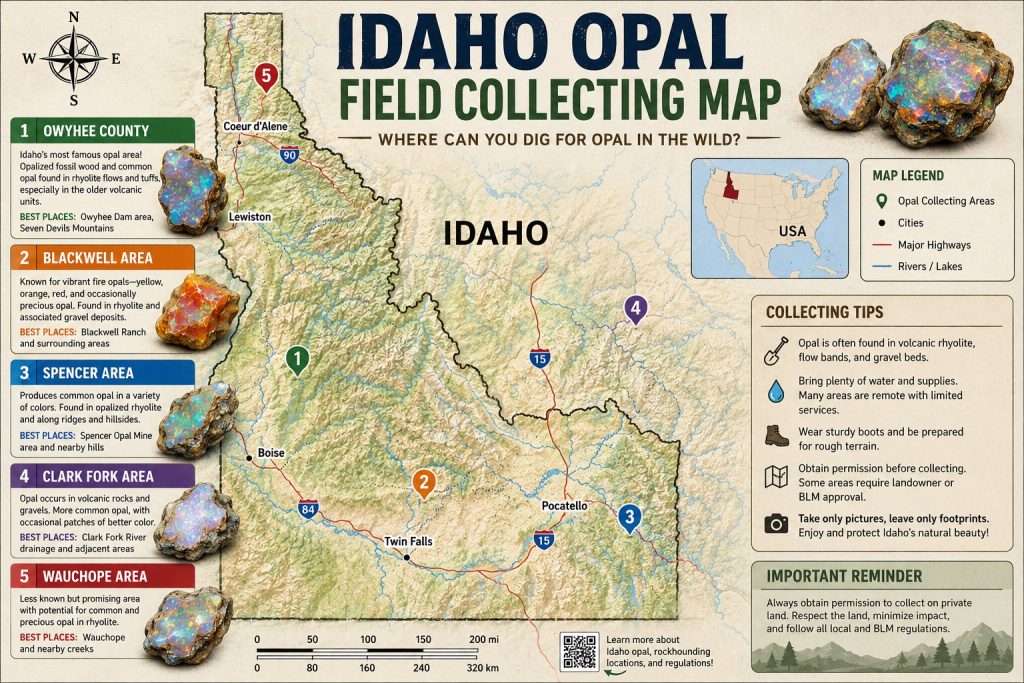
While the Spencer Opal Mine is Idaho’s most famous commercial destination, the “Gem State” hides millions of dollars in precious opals across its rugged public lands. For hardcore rockhounds who prefer the thrill of discovery in the deep wilderness over commercial digging piles, out-of-the-way backcountry locations offer incredible potential. This guide reveals the top wild opal locations in Idaho, the essential tools you will need, and the critical Bureau of Land Management (BLM) rules to keep your expedition legal.
🗺️ The Wild Opal Map: Top 4 Idaho Locations
Beyond the manicured rock piles of Spencer, Idaho’s volcanic history has left rich gemstone deposits scattered across the state.
   [ Idaho Opal Locations Map ]

   (North)  • Moscow (Precious Fire & Matrix Opals)
            |
            • Spencer (Wild backcountry public veins)
            |
   (Central)• Camas Creek (Hyalite & Common Opals)
            |
   (South)  • Squaw Butte / Emmett (Cherry & Fire Thundereggs)
1. Moscow Mountain (Latah County)
Located in northern Idaho near the Washington border, the area around Moscow is legendary for producing some of the highest-quality precious fire opals in the Pacific Northwest. Unlike the layered Spencer varieties, Moscow opals often form as thick, stable nodules or matrix pockets inside decomposed granite and basalt.
-
- What to look for: Brilliant pinfire patterns with strong red and green flashes trapped in a dark or milky matrix.
2. Squaw Butte & Emmett (Gem County)
Situated just north of Boise, the Squaw Butte region is a paradise for volcanic rock collectors. The primary targets here are Opal Thundereggs—spherical, nodular rock formations that look ordinary on the outside but contain magnificent hidden centers.
-
- What to look for: Break open these chalcedony nodules to find vibrant cherry-red fire opal, translucent jelly opal, or banded common opal layers.
3. Camas Creek (Clark/Lemhi County Border)
Further into central Idaho’s volcanic wilderness lies Camas Creek. This area is rich in volcanic ash beds where silica-rich groundwater has pooled for millions of years.
-
- What to look for: Glassy, water-clear Hyalite opal that glows brilliantly under shortwave ultraviolet light, alongside large deposits of colorful common opal.
4. Spencer Backcountry (Public BLM Lands)
While the commercial mines own the richest veins, the public lands surrounding Spencer still hold untamed, scattered deposits of layered opal in the native rhyolite cliffs.
-
- What to look for: Weathered outcrops of white or pinkish rhyolite showing micro-flashes of color along fresh fractures.
⛏️ Wilderness Gear: Tools for the Remote Hunt
Hunting for opals in the wild requires heavier and more specialized equipment than digging in commercial piles:
-
- Heavy Cold Chisels & Crack Hammer: Wild volcanic rock is incredibly tough; a light geologists’ hammer will bounce right off. You need a 3-lb crack hammer to fracture solid basalt and rhyolite outcrops.
- Long Pry Bar: Crucial for splitting open natural bedrock fractures where opal veins run deep.
- UV Flashlight (Shortwave): Essential if you are hunting in the late evening for Hyalite opals, which fluoresce a striking neon green under UV light.
- GPS & Topographic Maps: Many of these sites lack cell service. Always download offline maps before heading into the Idaho backcountry.
⚖️ The Law: Rockhounding Rules on Idaho Public Lands
Before you pack your bags, you must understand the legal differences between casual hobby collecting and illegal mining:
-
- BLM & US Forest Service Lands: Casual collecting of reasonable amounts of rocks and gemstones for personal, non-commercial use is generally permitted without a permit.
- The “Reasonable Amount” Rule: Federal guidelines usually limit hobbyists to a maximum of 25 pounds per day, plus one piece, with a total annual limit of 250 pounds per person.
- No Power Tools: You may only use hand tools (shovels, hammers, chisels, pry bars). The use of explosives, bulldozers, or motorized heavy equipment is strictly illegal.
- Watch Out for Active Mining Claims: Always verify that the land you are on is open to the public. Look out for marked wooden stakes or signs indicating an active mineral claim—digging on someone else’s active claim is federal claim-jumping.